As humans continue to develop technology, the idea of AI technology turning against its creators becomes less fiction and more science. The rate of evolution in technology exceeds the rate of human development, and each day we become more reliant on its operation and convenience to us. This scare is realized in many science-fiction movies, but has a quirky twist in the animated feature Summer Wars.
Directed by Mamoru Hosoda and released by Madhouse animation in 2009, Summer Wars takes place in a universe where people have developed a virtual world called OZ that parallels Earth. After creating an account in OZ, a person can choose to give their avatar any and all privileges of their real-world selves. In fact, OZ’s security is so good that even world leaders feel safe storing their nuclear codes on OZ. Havoc begins when the American Government releases an AI program—essentially a virus—called Love Machine into OZ. The AI works of its own volition, driven by the desire to learn and play games and steals accounts—along with their privileges—as a way to satiate that desire.
Summer Wars follows both real-world and virtual-world characters. For the most part, OZ continues to follow the physics displayed in the real-world, but diverges sometimes for the sake of caricature and fantasy. Analyzing the effects of scale, gravity, and squash and stretch in and out of the world of OZ creates both a contrast and connection to the real world.
Let’s begin with size and scale. Both size and scale are fairly consistent throughout the movie giving characters strong silhouettes and believability that they are not solely abstract. Since Natsuki’s avatar is so close in design to herself, it may be assumed that it is similar to that of a human. Her avatar is an average 7-heads high, while Natsuki herself is only about 6-heads high. At an average of 9.4in for the human head, we can estimate the height of other avatars next to Natsuki’s. (1) Alternatively, some of the avatars hold props and we can measure them that way. In the end, we find that the average avatar is around 3.5 to 4 feet tall. Just as in the real world, the smaller avatars have quicker more frantic movements. The human-sized avatars are a bit slower, and move as humans do.


When Love Machine assimilates avatars, it has the ability to summon them at any time. At its peak, love machine steals 412,308,249 accounts. When all of them are used at once, the individual avatars work in unison to create a singular entity. We believe that it is large because of its slow movements, but we know that it is large when we see its relative size.


Speaking of all the avatars brings up another point: flying. General travelling through OZ seems to be done via flying, but the characters stand on solid ground once a destination has been reached. Flying seems to have no rules: the characters have full control over when and where they go, stop, and change direction but they follow have a god sense of timing by using slow-ins and slow-outs. Idle avatars as well as objects in OZ’s flight zone seem to float as if they were in zero gravity space. If we are thinking of applying Newton’s Laws here, only the idle seems to make sense. Otherwise, the unbalanced forces that allow the avatars to fly is willpower alone.

Gravity does exist in the realm of OZ. In the beginning we can see avatars falling and being pushed down. Gravity and air currents both effect clothing and hair.


Fighting can be done on any device—computer, hand-held game, cellphone, etc.—and is shown as a series of button commands that translates into the character moving. It is not quite clear how such differing ways of coding translate to doing so much in the virtual world. There are fighting scenes between King Kazma and Love Machine that establish them as solid beings. They fight like humans with strong and solid bones.
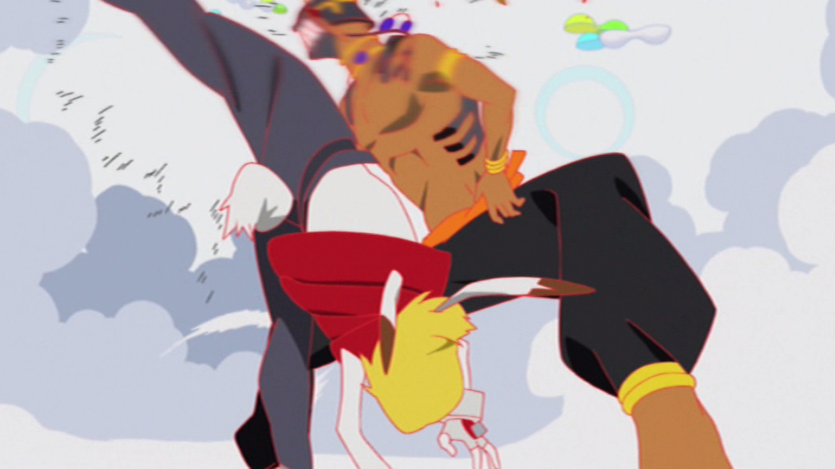
During the final scenes of the movie, King Kazma delivers a final blow to Love Machine. Earlier it was established that Love Machine’s head was solid, perhaps due to its unknown power. Here we can see that Love Machine’s head is stretched beyond any physical reason due to the force of Kazma’s final punch.

This is at the climax of the movie. It is when we as the audience have accrued so much tension and disdain against the antagonist that we want justice to be served above and beyond reality. So we believe it when Love Machine’s head becomes bent in this way.
The physics for scale, gravity, and squash and stretch only display a fraction of the fantastic world that is Summer Wars. Real world physics—which are not talked about here, but since we live in the real world we already have a base to compare to—contrast the physics of the virtual world by establishing a connection to reality. By establishing similar physics in OZ, drama and tension are successfully added to the situation. When the laws of physics are broken, it is always with the intent to either emphasize imagination in the virtual world or to accent plot points in the movie.
Sources:
1. Human Head Height Chart < http://edge.rit.edu/edge/P13541/public/WorkingDocuments/Camera%20Resolution%20Validation.pdf>
2. Tank Volume." Tank Volume. The Engineering Tool Box, n.d. Web. 30 Sept. 2015. <http://www.engineeringtoolbox.com/cylinder-volume-d_364.html>
3. Game of Thrones Exposed: The Science of Skull Crushing." ScienceAlert. ScienceAlert Staff, 4 June 2014. Web. 30 Sept. 2015. <http://www.sciencealert.com/game-of-thrones-exposed-the-science-of-skull-crushing>
Let’s begin with size and scale. Both size and scale are fairly consistent throughout the movie giving characters strong silhouettes and believability that they are not solely abstract. Since Natsuki’s avatar is so close in design to herself, it may be assumed that it is similar to that of a human. Her avatar is an average 7-heads high, while Natsuki herself is only about 6-heads high. At an average of 9.4in for the human head, we can estimate the height of other avatars next to Natsuki’s. (1) Alternatively, some of the avatars hold props and we can measure them that way. In the end, we find that the average avatar is around 3.5 to 4 feet tall. Just as in the real world, the smaller avatars have quicker more frantic movements. The human-sized avatars are a bit slower, and move as humans do.

When Love Machine assimilates avatars, it has the ability to summon them at any time. At its peak, love machine steals 412,308,249 accounts. When all of them are used at once, the individual avatars work in unison to create a singular entity. We believe that it is large because of its slow movements, but we know that it is large when we see its relative size.

We can also calculate the speed they're travelling. These pictures are about, two frames apart, and at 4ft long, they travel a distance of about 24 feet. That makes 288 feet per second with Kazma getting pelted by thousands at a time.


Speaking of all the avatars brings up another point: flying. General travelling through OZ seems to be done via flying, but the characters stand on solid ground once a destination has been reached. Flying seems to have no rules: the characters have full control over when and where they go, stop, and change direction but they follow have a god sense of timing by using slow-ins and slow-outs. Idle avatars as well as objects in OZ’s flight zone seem to float as if they were in zero gravity space. If we are thinking of applying Newton’s Laws here, only the idle seems to make sense. Otherwise, the unbalanced forces that allow the avatars to fly is willpower alone.


Shown below is what a possible limit to flying in OZ is. At one point in the film, Love Machine is trapped and being flooded with water coming through circular vents. The stream of water in the example is a bit wider than Love Machine is tall, and we can calculate the stream’s force finding the gallons per that 6-foot diameter of water. (2) Love Machine tries to fly against the current, but is ultimately knocked down by 7,840N of falling water—that’s more than three-times the force needed to crush a human skull! (3)

So then, how much punishment can these characters take? The smaller, and weaker the avatar seems to be, the more leeway there is to make it squishier and cartoony. Love Machine jumps on Kenji’s replacement avatar and it squishes to show his character is weak. The character, though cartoony, does bleed and display damage, bringing-up the possibility of death in OZ.


This is at the climax of the movie. It is when we as the audience have accrued so much tension and disdain against the antagonist that we want justice to be served above and beyond reality. So we believe it when Love Machine’s head becomes bent in this way.
The physics for scale, gravity, and squash and stretch only display a fraction of the fantastic world that is Summer Wars. Real world physics—which are not talked about here, but since we live in the real world we already have a base to compare to—contrast the physics of the virtual world by establishing a connection to reality. By establishing similar physics in OZ, drama and tension are successfully added to the situation. When the laws of physics are broken, it is always with the intent to either emphasize imagination in the virtual world or to accent plot points in the movie.
1. Human Head Height Chart < http://edge.rit.edu/edge/P13541/public/WorkingDocuments/Camera%20Resolution%20Validation.pdf>
2. Tank Volume." Tank Volume. The Engineering Tool Box, n.d. Web. 30 Sept. 2015. <http://www.engineeringtoolbox.com/cylinder-volume-d_364.html>
3. Game of Thrones Exposed: The Science of Skull Crushing." ScienceAlert. ScienceAlert Staff, 4 June 2014. Web. 30 Sept. 2015. <http://www.sciencealert.com/game-of-thrones-exposed-the-science-of-skull-crushing>


