Wednesday, October 21, 2015

Outline of the Second Term Paper

Science Fact or Cinematic Fiction?

Introduction

  • Gravity - "the force that attracts a body toward the center of the earth, or toward any other physical body having mass. For most purposes Newton's laws of gravity apply, with minor modifications to take the general theory of relativity into account."
  • 8 miles in diameter is roughly the smallest a planet would need to be to sustain a running human.
  • Thesis: Gravity is often re-imagined in movies and video games to create a satirical or fantastic universe.


Body

1. Family Guy

  • S4 E17 "The Fat Guy Strangler" - Brian throws an apple and a TV at Peter to show that he has his own gravitational field.
  • Objects don't begin to display a gravitational field until 
  • Escape velocity would be ridiculously low.
  • Ridiculous, but funny.
2. Katamari

  • A Katamari is described as a "sticky" ball, but displays properties that is more likely to be gravitational pull due to super-density. As the ball gets larger it can attract larger items, and sometimes items can be knocked off.
  • The Prince and his Cousins are also inexplicably unaffected by the Katamari even though they are small and remain small.
  • Escape Velocity would change depending on the size. 
3. Ratchet and Clank Future: A Crack in Time
  • Travelling through space, you can land on smaller planets, some not much bigger than your own ship sometimes, yet they display all the same gravitational properties as bigger planets.
  • Jumping animations are the same when Ratchet should be able to push off from the planet more easily.
  • The jumping and walking animations are also the same when Ratchet is using his magnetic boots, but it should be more difficult to lift his feet if it is truly supporting his weight
  • Escape velocity of the smaller planets would be very low.


Conclusion

  • The physics in animation is often broken, and what better way to break it than with an invisible force of the known world? Games and movies may not always be accurate, but sometimes they are accurate to how we feel. When we jump it's usually not that high-average adult height is about 16 inches-but sometimes we feel as if we're flying 16 feet in the air. Sometimes we really can feel so obese that objects begin to gravitate towards us.
  • It doesn't matter if the physics are real as long as we believe the story, because without an audience, media has no purpose. So we push that reality, that fantasy, and that feeling to make the audience laugh, keep them immersed, keep them entertained.
Reference:
  • http://www.askamathematician.com/2010/04/q-how-big-does-an-object-have-to-be-to-gravitationally-attract-a-human-or-have-a-molten-core/

Saturday, October 17, 2015

Side Quest: Cal Academy of Sciences

Today I dragged my boyfriend along to the Cal Academy of Sciences in San Francisco. It's a fantastic place where you can learn, admire, and even interact with various animals and minerals. Here's us in Golden Gate park on our way into the academy.

We went inside and got some tickets for a planetarium showing, then headed downstairs to the aquarium. This is the first time I've seen their albino alligator, Claude, out in the open! 


(Japanese Sea Nettle, Philippines coral reef, Spotted Jellies,
Cleopatra Beetles, Python Cuddle Puddle)

We saw "Habitat Earth" in the planetarium. It was an animated experience which spoke about the way organisms are connected, and our impact as humans on those ecosystems. Especially with the advent of technology, we are able to carry foreign species around the globe, creating extreme changes in earth's habitats.

I prefer their other show "Fragile Planet", but the planetarium is always a treat to be in anyway.

After the show, we were able to see a travelling exhibit from New Zealand about whales. Wyatt is standing next to them so we can see a bit of size comparison. They also had tools from the Maori (the indigenous people of New Zealand). I was informed later... that photography is prohibited. Sorry.


Downstairs from the display,is the tropical vivarium where they let butterflies and Macaws fly free. They also display quite a few amphibians, reptiles, and arachnids (behind glass).

There was a final display called "Color of Life". A display of various animals' ability to camouflage. I wanted to see their Day Octopus very badly, but I think they took him out of the tank. :( 

Here's a small newt, though.


And that was our day. Here's a picture of a sick pressed penny I got. Also a sketch I did of a horny toad with a wristband and my ticket from the Academy.

Tuesday, October 13, 2015

Reverse Video Reference

Hoo boy this took a lot longer than I thought. ;; Out of context these look awkward and hilarious, but we were supposed to reproduce the reference that would be used for a provided animation. Thanks Michael and Jasmine for teaming-up to film!


(Now with bonus music)


Wednesday, October 7, 2015

Stop Motion Animation of Falling

Hello there. This week we began learning about the trials and tribulations of stop-motion animation. In order to create the gravity test featured below I took some quick steps:


1. Create a plan! I had a different idea, where the bomb was going to roll down and bounce, but it was far too big and heavy for me to feasibly do that. So Octopus we went. After making ideas for the arcs, I marked the physical path with masking tape.


2. Action! Using the plan, I safety-pinned the Octopus's arms together to create the streamline shape that travels when it picks-up speed and shot all of those frames. Generally I just used masking tape to stick it to the wall (and to tilt the lamp). After shooting the frames of the arms together, I shot the frames with the arms jumbled about or in otherwise strange shapes. I had a tough time piecing together the turns, because the face would be in some arcs and not others. So that was a challenge I should have planned for better.


3. Edit! In a lot of the frames I accidentally left my phone and tape rolls lying about. I went in digitally to edit the pictures with clean frames, or at least less distracting pixels. I also bumped the tripod a few times trying to review footage unfortunately causing some of the frames jiggle. Once those were cleaned-up, it was simply a matter of putting them in a timeline and adjusting timing/cutting frames to create the illusion of bounce.

And here's the final short:


Thanks for reading!

Wednesday, September 30, 2015

The Laws of Physics in an Animation Universe

     As humans continue to develop technology, the idea of AI technology turning against its creators becomes less fiction and more science. The rate of evolution in technology exceeds the rate of human development, and each day we become more reliant on its operation and convenience to us. This scare is realized in many science-fiction movies, but has a quirky twist in the animated feature Summer Wars.

     Directed by Mamoru Hosoda and released by Madhouse animation in 2009, Summer Wars takes place in a universe where people have developed a virtual world called OZ that parallels Earth. After creating an account in OZ, a person can choose to give their avatar any and all privileges of their real-world selves. In fact, OZ’s security is so good that even world leaders feel safe storing their nuclear codes on OZ. Havoc begins when the American Government releases an AI program—essentially a virus—called Love Machine into OZ. The AI works of its own volition, driven by the desire to learn and play games and steals accounts—along with their privileges—as a way to satiate that desire.

     Summer Wars follows both real-world and virtual-world characters. For the most part, OZ continues to follow the physics displayed in the real-world, but diverges sometimes for the sake of caricature and fantasy. Analyzing the effects of scale, gravity, and squash and stretch in and out of the world of OZ creates both a contrast and connection to the real world.

     Let’s begin with size and scale. Both size and scale are fairly consistent throughout the movie giving characters strong silhouettes and believability that they are not solely abstract. Since Natsuki’s avatar is so close in design to herself, it may be assumed that it is similar to that of a human. Her avatar is an average 7-heads high, while Natsuki herself is only about 6-heads high. At an average of 9.4in for the human head, we can estimate the height of other avatars next to Natsuki’s. (1) Alternatively, some of the avatars hold props and we can measure them that way. In the end, we find that the average avatar is around 3.5 to 4 feet tall. Just as in the real world, the smaller avatars have quicker more frantic movements. The human-sized avatars are a bit slower, and move as humans do.


     When Love Machine assimilates avatars, it has the ability to summon them at any time. At its peak, love machine steals 412,308,249 accounts. When all of them are used at once, the individual avatars work in unison to create a singular entity. We believe that it is large because of its slow movements, but we know that it is large when we see its relative size.


We can also calculate the speed they're travelling. These pictures are about, two frames apart, and at 4ft long, they travel a distance of about 24 feet. That makes 288 feet per second with Kazma getting pelted by thousands at a time.


     Speaking of all the avatars brings up another point: flying. General travelling through OZ seems to be done via flying, but the characters stand on solid ground once a destination has been reached. Flying seems to have no rules: the characters have full control over when and where they go, stop, and change direction but they follow have a god sense of timing by using slow-ins and slow-outs. Idle avatars as well as objects in OZ’s flight zone seem to float as if they were in zero gravity space. If we are thinking of applying Newton’s Laws here, only the idle seems to make sense. Otherwise, the unbalanced forces that allow the avatars to fly is willpower alone.


Gravity does exist in the realm of OZ. In the beginning we can see avatars falling and being pushed down. Gravity and air currents both effect clothing and hair.


     Shown below is what a possible limit to flying in OZ is. At one point in the film, Love Machine is trapped and being flooded with water coming through circular vents. The stream of water in the example is a bit wider than Love Machine is tall, and we can calculate the stream’s force finding the gallons per that 6-foot diameter of water. (2) Love Machine tries to fly against the current, but is ultimately knocked down by 7,840N of falling water—that’s more than three-times the force needed to crush a human skull! (3) 


     So then, how much punishment can these characters take? The smaller, and weaker the avatar seems to be, the more leeway there is to make it squishier and cartoony. Love Machine jumps on Kenji’s replacement avatar and it squishes to show his character is weak. The character, though cartoony, does bleed and display damage, bringing-up the possibility of death in OZ.


     Fighting can be done on any device—computer, hand-held game, cellphone, etc.—and is shown as a series of button commands that translates into the character moving. It is not quite clear how such differing ways of coding translate to doing so much in the virtual world. There are fighting scenes between King Kazma and Love Machine that establish them as solid beings. They fight like humans with strong and solid bones.


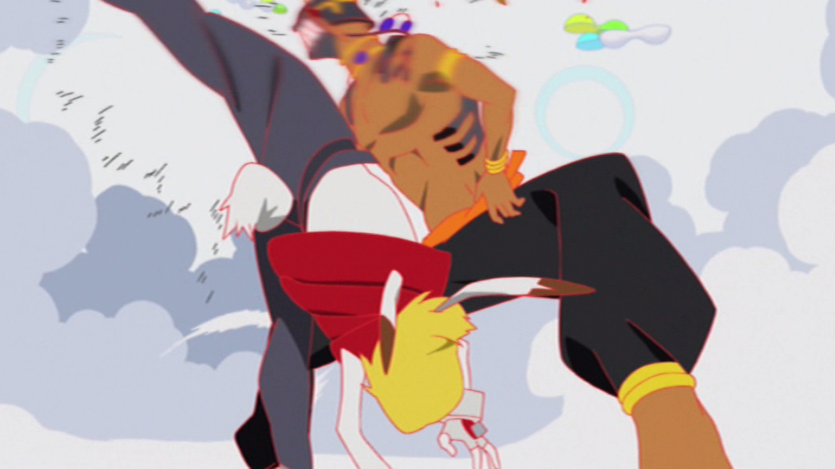
     During the final scenes of the movie, King Kazma delivers a final blow to Love Machine. Earlier it was established that Love Machine’s head was solid, perhaps due to its unknown power. Here we can see that Love Machine’s head is stretched beyond any physical reason due to the force of Kazma’s final punch.


     This is at the climax of the movie. It is when we as the audience have accrued so much tension and disdain against the antagonist that we want justice to be served above and beyond reality. So we believe it when Love Machine’s head becomes bent in this way.

     The physics for scale, gravity, and squash and stretch only display a fraction of the fantastic world that is Summer Wars. Real world physics—which are not talked about here, but since we live in the real world we already have a base to compare to—contrast the physics of the virtual world by establishing a connection to reality. By establishing similar physics in OZ, drama and tension are successfully added to the situation. When the laws of physics are broken, it is always with the intent to either emphasize imagination in the virtual world or to accent plot points in the movie.


Sources:
1. Human Head Height Chart < http://edge.rit.edu/edge/P13541/public/WorkingDocuments/Camera%20Resolution%20Validation.pdf>
2. Tank Volume." Tank Volume. The Engineering Tool Box, n.d. Web. 30 Sept. 2015. <http://www.engineeringtoolbox.com/cylinder-volume-d_364.html>
3. Game of Thrones Exposed: The Science of Skull Crushing." ScienceAlert. ScienceAlert Staff, 4 June 2014. Web. 30 Sept. 2015. <http://www.sciencealert.com/game-of-thrones-exposed-the-science-of-skull-crushing>

Sunday, September 20, 2015

Outline of First Term Paper

The Laws of Physics in Summer Wars (2010)

Introduction

Thesis: Most of Summer Wars takes place in a virtual world, but obeys the laws of physics to create an emotional connection and dramatic gravity.

Body

1. Size and scale
  • In the real world, one of the uncles brings a large boat to the property and puts it in a pond next to the house. A large amount of water is displaced to show how big the boat is in real life. The water moves slowly and it feels large.
  • When Love Machine assimilates its 1,000,000,000 (check number) accounts stolen, it takes the form of all the separate avatars standing together. We know it’s huge because it moves slowly, but its true scale is revealed when a stream of fast-moving avatars are sent at Kazma.
  • The avatars are moving at a speed of (measure this using frames from the movie)
  • Therefore the larger avatar is (measure the height based on how quickly avatars are moving in the shot with Love Machine)
  • In general, smaller creatures are jumpier, squishier, and zip around more frantically.
2. Gravity and flying
  • We have a sense of how the real world works, which is by all the normal laws of physics.
  • In the virtual world, gravity is established by certain scenes such as characters falling off of platforms; however, when the rules of the universe change, the characters are able to fly, seemingly without consequence.
  • Flying seems to have no rules, the characters have full control over when they go, stop, and move but follow believable timing. When they stop, there is still a bit of movement, like a rock floating through space.
  • Helps support the fantasy factor of the virtual world
3. Squash and Stretch

  • Love Machine jumps on Kenji’s replacement avatar and it squishes to show his character as weak and squishy. The character, though cartoony, does bleed and shows the feeling of damage and possibly death in OZ.
  • There are fighting scenes between King Kazma and Love Machine that establish them as solid beings. They fight like human fighters with strong/solid bones.
  • During the final scenes of the movie, King Kazma delivers a final blow to Love Machine. We have already established that Love Machine’s head is solid, but in this scene Love Machine’s head is stretched beyond any physical realm due to the force of King Kazma’s punch.
  • We believe this because as the audience feels tension and disdain build-up against the antagonist, we want justice to be served in a way that is beyond reality.

Conclusion

  • The contrast of the real world’s physics to the virtual world’s physics establishes a feeling of reality and therefore dramatic tension to the situation.
  • When the laws of physics are broken it is either to create a feeling of fantasy in the virtual world or to accent plot points in the movie.
  • Some characters in OZ are cuter or more cartoony than others, and they follow equally cartoony physics to accent their character traits (and vice-versa for realistic characters).

Sunday, September 13, 2015

Video Analysis of Path of Action

This week, Michael and I tried using a different, higher-quality camera. However, we couldn't figure out how to change the format from .MTS to .MP4. Luckily it worked in Tracker anyway, but I think some of the data became corrupted. :/


Footage of the Five Jumps alone:


Footage of one of the jumps in tracker: